
How much does an online store for a publisher cost?

Cuánto cuesta una tienda online para una editorial — Mister Mikel

An online store for a publisher costs between €2,970 and €6,860 + VAT, depending on the catalog and how far you want to go. At Mister Mikel we build online stores for publishers, bookshops, foundations and cultural centers from Vitoria-Gasteiz, Spain, and these are our published prices — not a “request a quote” that forces you into three calls to find out one figure.

This article breaks down what each plan includes, what costs exist beyond the project (the ones almost nobody mentions) and, with the same frankness, when it’s not worth building one.

What are the exact prices?

We work with three plans. The difference between one and the next isn’t “more of the same”: each plan solves a different need.

PlanPrice (+ VAT)Who it’s forWhat’s included
Basicfrom €2,970The imprint that wants to start selling without intermediariesCatalog of print books and ebooks, carefully built book pages, payments and shipping configured, one language
Grow€4,985The project with a community or a bilingual audienceEverything above + a second language (Basque, Catalan, Galician or English), preorders, bundles and collections, connected newsletter
Expand€6,860The institution or the large catalogEverything above + international sales with multi-currency, migration of a large catalog, members’ area, integrations with distributors

All of them include the same foundation: we hand over the store with the catalog loaded and show you how to use it in ten minutes. From then on you run it yourself, without calling anyone to change a price.

Why that range and not €600 or €20,000?

Because the market has two extremes and a gap in the middle. Below are the €300–800 templates: a generic store where your books look like sneakers, with empty product pages and nobody who has thought about your catalog. Above, five-figure custom builds, designed for companies with their own technical department.

A publisher needs neither. It needs a store on a solid platform, with the catalog well organized by collection, book pages that say something more than the page count, and an admin panel anyone on the team can understand. That’s what the €2,970 to €6,860 range covers.

What costs are there beyond the project?

Almost nobody mentions this on their website, and then the surprises arrive. Beyond the project, an online store has three recurring costs that you pay directly, not to us:

  • The platform subscription. Shopify works on a monthly subscription, contracted directly with them. It’s what saves you servers, updates and security scares.
  • The payment gateway fee. A small percentage per transaction, as in any business that accepts cards. You only pay when you sell.
  • The domain. A few euros a year.

And monthly maintenance with us? It’s not mandatory, and that’s exactly the idea: we build the store so you don’t need us day to day. If you get stuck, we’re still a message away.

Which plan does your project need?

Two real cases help you place yourself, one at each end:
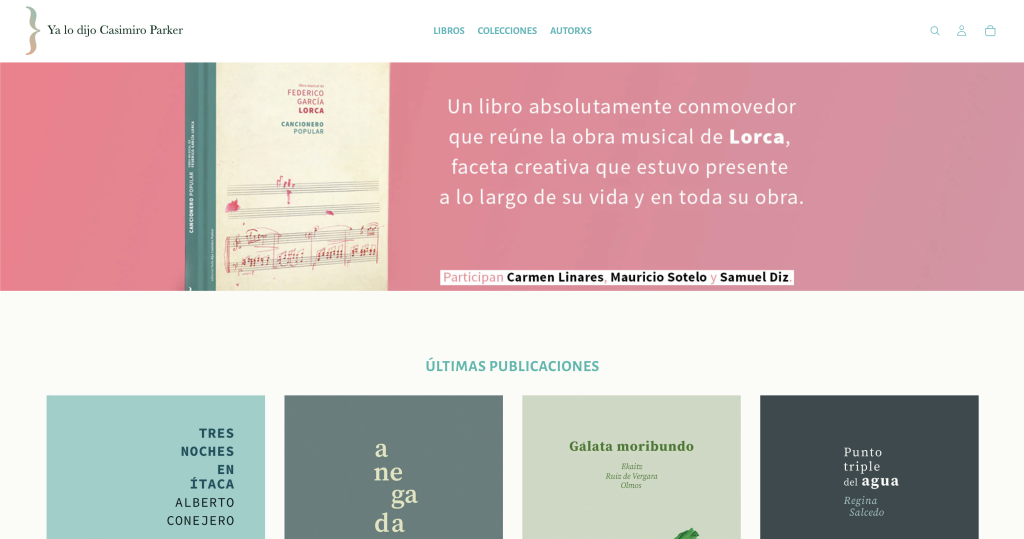
Ya lo dijo Casimiro Parker

Ya lo dijo Casimiro Parker is an independent publisher in Madrid with almost two decades publishing poetry and fiction and more than a hundred titles in collections. Its store shows that a small imprint can have a store worthy of its catalog without a multinational’s budget.
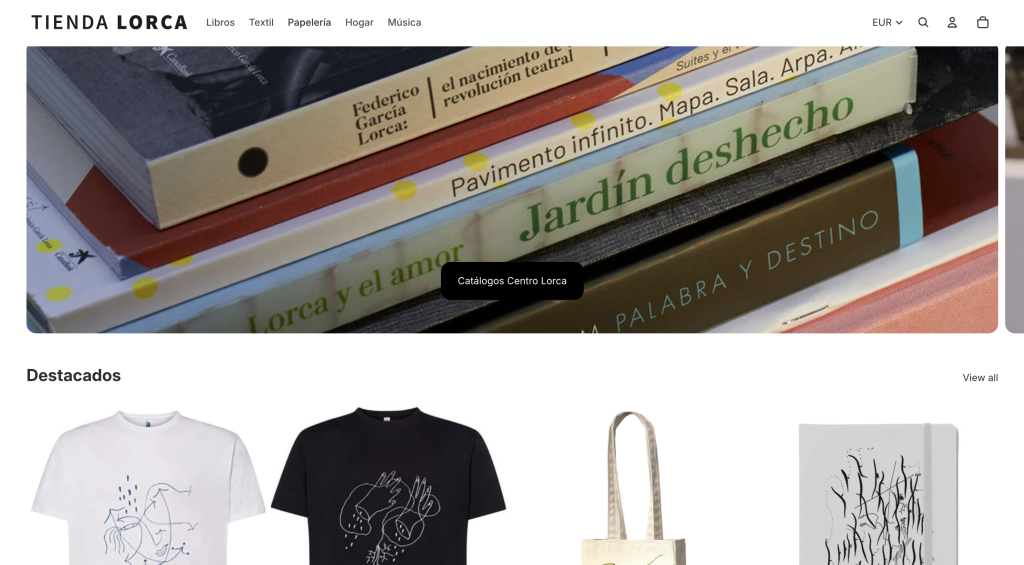
Tienda Lorca

The Centro Federico García Lorca in Granada is at the other end: an institution with a distinctive cultural catalog that also sells outside Spain, including sales in dollars. There we’re already talking about multi-currency and a large catalog — Expand territory.

The quick rule: if you’re starting from scratch with your catalog, Basic. If you have a community, a bilingual audience or want preorders, Grow. If you’re an institution or you’re migrating a catalog of hundreds of titles, Expand. And if in doubt, tell us about your case and we’ll tell you which one fits — we reply within 24 hours.

What if I have a grant or subsidy?

We adapt the project. If you’ve been awarded a grant or are going to apply for one, we adjust the scope and the budget so it fits what the grant covers or reaches the amount you need to justify. We don’t handle the application for you, but we do structure the project to fit it — that’s what flexible-scope plans are for.

When is it NOT worth building one?

Let’s be frank; there are others for selling smoke. A store of your own isn’t worth it if:

  • You publish one title every two years and sell at launches. With that volume, a simple payment link and your newsletter do the job, with no project involved.
  • Nobody on the team is going to give it even an hour a month. We leave the store ready, but you upload the new books. If there’s nobody for that, the problem isn’t the website.
  • Your only motivation is “we have to be on the internet”. Being there doesn’t sell. Selling sells.

If you’ve recognized yourself in any of these, save your money — and if things change a year from now, we’ll still be here. For everyone else, the math is different: every sale that goes through an intermediary today leaves margin and readers there. We talk about that in how to sell books online without depending on Amazon.


FAQ

How much does an online store for a small publisher cost?

A store ready to sell print books and ebooks, with the catalog loaded and payments configured, starts at €2,970 + VAT (Mister Mikel’s Basic plan). It’s the entry point for an imprint that wants to sell without intermediaries.

What’s the difference between the €2,970, €4,985 and €6,860 plans?

Basic (€2,970) covers catalog, book pages, payments and shipping in one language. Grow (€4,985) adds a second language, preorders, bundles and a connected newsletter. Expand (€6,860) adds international sales with multi-currency, migration of large catalogs, a members’ area and integrations with distributors.

Are there monthly costs after the project?

Yes, three, and they’re paid directly to each provider: the platform’s monthly subscription (Shopify), the payment gateway’s per-transaction fee and the domain. Agency maintenance isn’t mandatory: the store is built for you to manage yourself.

How long does it take to have the store up and running?

A simple store is usually ready in a few weeks. We work in stages, with something concrete to see at each one, and we hand it over with the catalog loaded.

Can I pay for the project with a grant?

If you’ve been awarded a grant or are going to apply for one, we adapt the project’s scope and budget so it fits what the grant covers or reaches the amount to be justified. We don’t handle the application, but we structure the project to fit it.

What if I only want the theme?

Parker, our Shopify theme for bookshops and publishers, is free if you install it yourself. If you want us to install it and adapt it to your catalog, that’s a separate quote, well below the plans. The prices above are for when we build the whole store.


In short

An online store for a publisher costs between €2,970 and €6,860 + VAT depending on the plan: Basic to start selling, Grow to reach your whole community, Expand for large, international catalogs. On top of that come three recurring costs paid to the provider (platform, gateway and domain), and no mandatory maintenance: you run the store yourself. And if your volume doesn’t justify it yet, we’ll tell you just as plainly.


Keep reading

How to sell books online without depending on Amazon

libros de una editorial independiente

Selling books online without depending on Amazon is possible, legal and less expensive than it seems: an online store of your own for a publisher starts at €2,970 + VAT and is usually up and running in a few weeks. At Mister Mikel we build online stores for publishers, bookshops, foundations and cultural centers from Vitoria-Gasteiz, Spain, and this article shares what we’ve learned doing it.

The reason to take the step is simple. When Amazon sells your book, you supply the catalog and they keep the margin, the data and — this is the serious part — the relationship with your reader.

It’s not that Amazon is the devil. It’s that it doesn’t work for you.

What do you lose on every Amazon sale?

On every marketplace sale you lose three things: part of the margin, the buyer’s data and the chance to talk to them again. The discount is the least of it. The serious part is that this reader is recorded in Amazon’s database, not in yours. You can’t write to them when you release the next title in the series. You can’t invite them to the launch. For you, they don’t exist.

The difference, in a table:

Selling on AmazonSelling in your store
Margin per saleShared with the marketplaceAll yours (minus the payment fee)
Reader dataAmazon’sYours
Newsletter and communityImpossible: you don’t know who boughtEvery purchase adds a contact
PreordersYou don’t control the formatYou launch them yourself, whenever you want
Book pageStandard templateYou tell it the way you want
DependenceTheir rules, their changesYour platform, your rules

A publisher lives on two things: its catalog and its community. Giving away the second to move the first is a bad deal, especially when the alternative costs less than it seems.

What mistakes do publishers make when selling online?

We’ve been building stores for cultural projects for years, and the pattern almost always repeats:

  • Confusing “being on the internet” with “selling on the internet”. A pretty website with a PDF catalog doesn’t sell. It informs, at most.
  • The hijacked website. Someone built it years ago and today changing a price means calling, waiting and paying. The result: nobody touches it and the catalog goes stale.
  • Handling orders by hand. Emails, bank transfers, a spreadsheet and half a Saturday. It works until it stops working — usually in the middle of a preorder campaign.
  • Five tools that don’t talk to each other. The store on one side, the newsletter on another, the catalog in a third. And you in the middle, acting as the glue.

How do you know if this is you?

Three quick questions. If you answer no to any of them, you have homework:

  1. Can you change the price of a title right now, yourself, without calling anyone?
  2. Do you know the name and email of your last twenty buyers?
  3. Could you open a preorder this week if you sign off an edition tomorrow?

A well-built store of your own answers yes to all three. And we’re not talking about a pharaonic project: we’re talking about a store with your catalog in book pages that make people want to buy, payments and shipping configured, and an admin panel anyone on your team can understand.

And the fixed book price?

In Spain, the retail price of a book is set by the publisher and is the same in every channel, with a maximum discount of 5% (Ley 10/2007, the law on reading, books and libraries). This, sometimes seen as a drawback, actually plays in your favor: Amazon can’t sell your book cheaper than you do. The reader pays the same in your store as there — the difference is who keeps the margin and the contact. In your store, you do.

How do you build a store you can run yourself?

Our philosophy at Mister Mikel is short: we build it, you keep it, you run it. We build the store, leave the catalog loaded, and on handover day we show you how to use it in ten minutes. From then on you don’t need us for the day-to-day — and that, which sounds like a detail, is the heart of the matter.

A real example: Ya lo dijo Casimiro Parker, an independent publisher in Madrid with almost two decades publishing poetry and fiction and a catalog of more than a hundred titles spread across collections. We built them a store where the catalog looks after itself: new releases, backlist, collections. No intermediary platforms, no marketplace commissions, and every reader recorded in their own house, not someone else’s.

And if you’re wondering whether this also works for something bigger: the Centro Federico García Lorca in Granada sells its cultural catalog from its own store, including international sales in dollars. Same method, different scale.

What does it cost and how long does it take?

Straight to the point: a store ready to sell starts at €2,970 + VAT, and a simple store is usually up and running in a few weeks. There are three plans — €2,970, €4,985 and €6,860 — covering everything from the small imprint to the institution with a large catalog. The details are on our page about online stores for publishers and cultural projects.

An honest caveat before we finish

Leaving Amazon doesn’t mean deleting yourself from Amazon. For many publishers it makes sense to stay there as a shop window — some readers only buy there. The difference lies in where you put the center: if your main channel is your store, Amazon is an add-on that brings extra sales. If your main channel is Amazon, you are the add-on. And that position costs dearly over the years.


FAQ

Is it legal to sell my books directly from my website?

Yes. As a publisher or bookshop you can sell directly to readers from your own online store. In Spain the fixed book price applies (Ley 10/2007), so the price is the same on your website as in any other channel, with a maximum discount of 5% — what changes is the margin you keep and the relationship with the buyer.

How much does an online store for selling books without Amazon cost?

A store ready to sell starts at €2,970 + VAT. At Mister Mikel we work with three plans — €2,970, €4,985 and €6,860 — ranging from a small imprint’s simple catalog to an institution’s international, multi-currency sales.

Will I need tech skills to manage it?

No. That’s precisely the criterion we build every store by: adding a title, changing a price or launching a preorder should take a couple of clicks, without calling anyone. We show you how to run it on handover day.

Can I sell ebooks as well as physical books?

Yes. The ebook delivers itself: the reader pays and downloads it on the spot. You can sell the print and digital editions of the same title, each with its own price.

Which platform is used for the store?

For most publishers we recommend Shopify, because it can be managed without tech skills and it handles growth; WooCommerce comes in when something very custom is needed. We are members of the Shopify Partner program and advise case by case.


In short

Selling books online without depending on Amazon means having a store of your own where the catalog, the margin and — above all — the reader are yours. Thanks to Spain’s fixed book price, your price is the same as Amazon’s; what changes is who keeps the value of each sale. It doesn’t require tech skills or a multinational’s budget: a well-built store starts at €2,970 and you run it yourself.

Keep reading

Where to sell your publishing house’s books: own store, Amazon, Publica.la and Todostuslibros, with numbers

In Spain, for every book a publisher sells through the traditional channel, between 55% and 60% of the price before VAT stays with the distributor and the bookshop, according to the breakdown published by Mariana Eguaras (2024). In direct sales, the publisher keeps around 95%. Between one end and the other there are four or five routes, and almost nobody compares them with the same math. Here they all are with a €20 book: how much you keep, what you pay as a fixed cost and who each one makes sense for.

Quick summary

The figures are for a book with a €20 cover price (€19.23 before VAT), before paying the author, the printer and shipping.

ChannelWho sellsWhat you keep per bookFixed costThe reader belongs to
Bookshops via distributorThe bookshop€7.70 to €8.65NoneThe bookshop
TodostuslibrosThe bookshop€7.70 to €8.65NoneThe bookshop
Amazon as a sellerYou, in their storefrontAbout €16.20€39/month or €0.99 per saleAmazon
Publica.la, no-fee planYou, on their platformAbout €12.25NoneYou
Store from book-trade software (Weblib, Webedi)YouSame as your own storeSubscription, amount not publishedYou
Your own store (Shopify)YouAbout €18.50€24/month, plus setting it upYou

How much do you keep selling through bookshops and a distributor?

Through the usual channel, the publisher receives between 40% and 45% of the price before VAT. According to Mariana Eguaras, distributor and bookshop share between 55% and 60%, and the bookshop keeps between 25% and 40%. On a €20 book, that’s between €7.70 and €8.65 for you, out of which the author and the printer still have to be paid.

In return you get something no online store gives you: the book on a new-releases table, a bookseller who recommends it and a reader who didn’t know you. It’s not an expensive channel. It’s a channel that charges for work you can’t do yourself.

It fits if: you want to reach readers who don’t yet know you exist. In other words, always.

And Todostuslibros? Isn’t that direct sales?

No. Todostuslibros is the online storefront of Spain’s bookshops, not of its publishers. It belongs to CEGAL, the booksellers’ confederation, and its terms and conditions say it plainly: the platform is a mere service provider, and the contract with the reader is made by each bookshop. When it became a sales platform in 2020, the model was zero commission for the bookseller, as Xataka and the Asociación de Editores de Madrid reported at the time.

For your publishing house that means a book sold there is a book sold by a bookshop. It leaves you the same as the traditional channel, because it is the traditional channel with a search box. What it does do is show the reader which bookshop has your title, and that is worth a lot.

It fits if: you’re already in distribution. You don’t have to do anything, except keep your title records properly loaded so the book shows up as it should.

What do you keep selling on Amazon?

It depends on how you’re on Amazon, and there are two ways. If Amazon buys your books from the distributor, it’s one more bookshop and you keep what the traditional channel leaves. If you sell as a seller yourself, Amazon charges a 15% referral fee on books, plus €39 a month on the Professional plan or €0.99 per unit on the Individual plan, according to its pricing page for Spain.

On the €20 book, 15% is €3. You keep about €16.20 before VAT, and shipping is on you. On paper it’s a good margin. What the math doesn’t show is the rest: you don’t know who bought from you, you can’t write to them when the next title comes out, and you compete on the same page with second-hand copies of your own book.

It fits if: you want to be where people already search and you accept that this reader won’t be yours.

What do you keep with a platform like Publica.la?

With a commission-based platform you don’t pay to set it up, but you pay on every sale. Publica.la publishes three plans: one with no fee, with a 35% commission per sale plus USD 0.25 per transaction; another at USD 249 a month with 25%; and another from USD 492 a month with 15%. They include a store, a web and mobile reader, and file protection.

On the €20 book, the no-fee plan leaves you about €12.25. The USD 249-a-month plan leaves you a little over €14, but you need to sell quite a lot for the fee to pay off. Its strong point is digital books: if your catalog is ebooks and audiobooks and you want them read inside your own app, that’s what it’s built for.

It fits if: you sell mostly digital and would rather pay nothing until the first sale comes in.

And the stores that come with management software, like Weblib or Webedi?

They’re your own stores, but hanging from a management program. Trevenque, which has been making software for the Spanish book trade for more than thirty years, offers Weblib for bookshops, connected to its Geslib program, and Webedi for publishers, which syncs with Gesedi and has ecommerce and ebooks as add-on modules. The advantage is real: the catalog comes out of the same place where you already run the business.

In margin terms they behave like your own store, because the sale is yours and there’s no intermediary. What changes is the cost: Webedi works on a subscription, with support included, but Trevenque doesn’t publish the amount on its site. There’s no figure to put in the table; you have to ask for it.

It fits if: you already work with that management program, or you have thousands of titles and stock that changes daily. For a general bookshop it’s almost always the answer.

What do you keep with your own store?

With your own store you keep a little over 95% of the price before VAT, and the reader is yours. On Shopify’s pricing page for Spain, the Basic plan costs €24 a month and charges from 2.1% plus €0.30 for each card payment. On the €20 book that’s €0.72: you keep about €18.50.

The difference from the traditional channel is about €10 per book. If setting up the store costs €2,970, it pays for itself with about 300 books sold directly. It’s not a little and it’s not a lot: it’s a figure you can compare with your mailing list and your preorders.

Two things the math doesn’t say. Shipping and packing are on you, or the reader pays for them. And a store doesn’t bring readers: it sells to the ones who already follow you. If today you have nobody to tell, the 95% margin applies to very few books.

It fits if: you have your own catalog and a community, however small, that already buys from you.

So do you have to pick one?

No. Almost no publisher should pick a single channel. Bookshops bring new readers. Your own store earns more from the ones you already have. The useful question isn’t where do I sell, but which sale do I want to go through each place.

What tends to work: new releases and backlist in bookshops, as always, and in your store what only you can sell. Preorders, signed editions, bundles, the ebook, the merchandise. Spain’s book law (Ley 10/2007) requires respecting the fixed price, with a maximum discount of 5%, so you won’t be competing on price with your booksellers, nor should you want to.

It fits if: you’d rather bookshops remain your shop window and your store be your till.

How we do it at Mister Mikel

Mister Mikel is a web design and online store studio based in Vitoria-Gasteiz, Spain, specializing in publishers, bookshops and cultural centers. We build your own store on Shopify, with the catalog loaded and designed for your team to run. If what you have is thousands of other publishers’ titles with a management program behind them, we’ll tell you: that’s a different project. Plans and prices are at online stores for publishers and cultural centers.


Frequently asked questions

What’s the difference between selling on Amazon as a seller and Amazon buying your books from the distributor?

When Amazon buys from the distributor it acts as a bookshop: the margin you receive is that of the traditional channel, between 40% and 45% of the price before VAT. When you sell as a seller yourself, you pay a 15% fee per book plus a subscription, and you handle shipping. In both cases the customer belongs to Amazon, not to you.

Why doesn’t Todostuslibros replace a publisher’s own store?

Because the one selling there is the bookshop. Todostuslibros shows which bookshops have your book and lets people buy it, but the sale, the payment and the customer belong to the bookseller. For the publisher it’s visibility within the traditional channel, with the traditional channel’s margin.

Can a publisher sell in its own store without hurting its bookshops?

Yes, if it respects the fixed price. In Spain, Ley 10/2007 limits the discount to 5%, so the book costs the same in your store as in the bookshop. The usual approach is to keep for the store what the bookshop can’t offer: preorders, signed editions, bundles and your own products.

When does a commission-based platform pay off compared with a fixed-fee store?

It depends on how many books you sell a month. With a €20 book, a 35% commission costs you about €6 more per sale than your own store with a monthly fee. From about four sales a month, the €24 fixed fee already works out cheaper, not counting what it costs to set up the store. If you sell less than that, the commission is the prudent option.

What should you be clear about before comparing channels?

Four things: how much you keep per book today in the traditional channel, how many readers you can reach directly, what share of the catalog is digital and whether you work with preorders. With those four figures the table above becomes a decision. If any term sounds like gibberish, they’re explained in the publishing ecommerce glossary.


Keep reading


Sources

  • Mariana Eguaras, “Porcentajes de un libro impreso: cómo se reparten los ingresos en la edición tradicional” (2024, in Spanish).
  • Amazon, pricing page for sellers in Spain (accessed September 2026).
  • Publica.la, pricing page (accessed September 2026).
  • Shopify, pricing page (accessed September 2026).
  • Xataka, “800 librerías de barrio unidas para competir contra Amazon: así funciona Todostuslibros.com” (2020, in Spanish).
  • Asociación de Editores de Madrid, “Todostuslibros.com se transforma en plataforma de comercio online” (2020, in Spanish).
  • Trevenque, product pages for Weblib, Geslib and Webedi (accessed September 2026).
  • Todostuslibros.com, general terms and conditions (accessed September 2026).
  • Ley 10/2007, de la lectura, del libro y de las bibliotecas (Spain’s law on reading, books and libraries).